

There comes a point in every growing restaurant group when the branding that once felt exciting now feels… dated, scattered, or a little too DIY. Maybe you’ve expanded from one concept to three, your audience has evolved, or your menu has moved upmarket—but your visual identity, website, and guest touchpoints never caught up.
A brand refresh is the bridge between where you started and where your restaurant group is headed. Done well, it clarifies your positioning, brings cohesion across locations, and gives your team the tools they need to show up consistently—online and off. Done hastily, it results in a shiny new logo that doesn’t solve the deeper disconnects your guests and staff feel every day.
This post walks through how to start a strategic brand refresh for your restaurant group this year: one that respects your history, reflects your current reality, and supports the kind of growth you are aiming for over the next several years.
Why a Strategic Brand Refresh Matters for Restaurant Groups
A restaurant group is a living ecosystem: multiple concepts, teams, menus, and guest experiences all under one umbrella. As you grow, your brand can either reinforce that ecosystem—or fracture it. A strategic brand refresh gives you the chance to:
Re-align your story with what guests are actually experiencing now.
Create cohesion across locations and concepts without flattening their individuality.
Build a brand and website system that supports bookings, private events, and group initiatives instead of working against them.
This is not about changing everything. It is about thoughtfully updating the pieces that no longer fit, so your group can move forward with clarity and confidence.
Step 1:
Get Honest About What’s Working (and What Isn’t)
Before you talk colors, logos, or websites, you need a clear picture of your current brand reality. Think of this as your pre-refresh audit.
Gather a small cross-functional group: an owner or partner, a marketing lead, an operations leader, and one or two on-the-ground managers. Together, explore questions like:
Where does our restaurant group brand feel strongest right now? (Name recognition, visual identity, word-of-mouth, social presence.)
Where are we hearing guest confusion or seeing friction? (Online information, reservations, expectations vs reality, group positioning.)
Do all of our locations and concepts feel like they belong to the same “family”? If yes, how? If not, where are the disconnects?
Which brand assets feel embarrassingly outdated—or just “not us” anymore?
Capture concrete examples: screenshots of your website, photos of signage and menus, snippets of guest reviews, internal documents. This becomes your baseline. A strategic refresh starts with honesty, not assumptions.
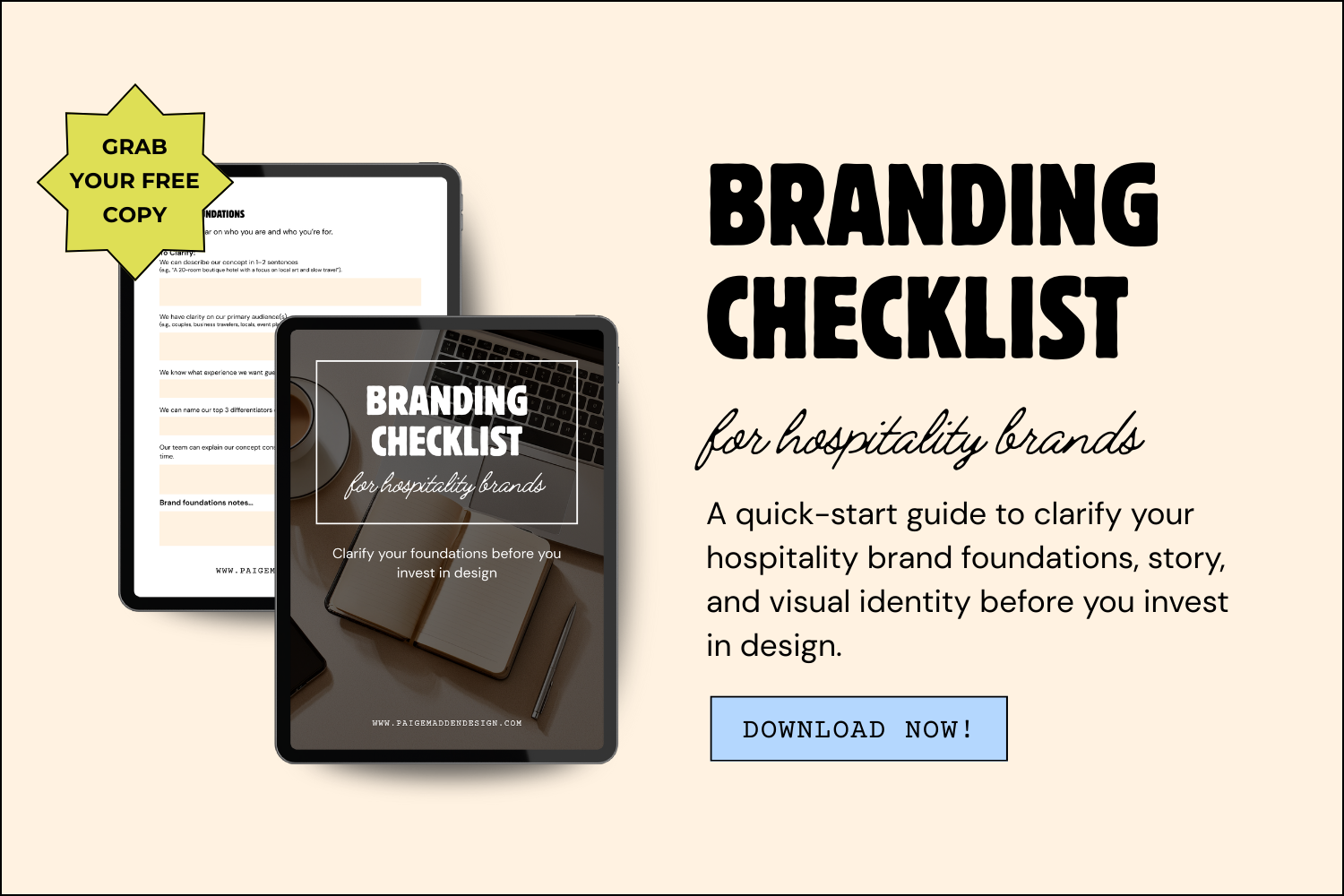
Suggested reading: How to Find Your Hospitality Brand’s Unique Point of View
Step 2:
Clarify Your Brand Architecture Across Concepts
One of the biggest differentiators between a single restaurant and a restaurant group is brand architecture: how your concepts relate to each other under one umbrella. Without clarity here, your refresh risks creating more confusion, not less.
Consider:
Is your group brand meant to be front-facing (for guests), or primarily internal/investor-facing?
Do your concepts share a common philosophy, aesthetic thread, or audience—or are they intentionally distinct?
How much “family resemblance” do you want between concepts? (Subtle visual nods, shared tone of voice, common website framework.
Common models include:
Branded House: The group name is prominent, and each concept is a variation under that umbrella.
House of Brands: Each concept has its own strong identity; the group brand sits more in the background.
Hybrid: A clear group brand plus distinct concepts with shared DNA.
Your architecture decision will guide everything from logo systems and color families to how your website navigation is structured.
Step 3:
Define or Revisit Your Brand POV and Positioning
Your restaurant group has grown and changed; your point of view and positioning need to reflect that. This is where you answer: “What do we stand for, and where do we sit in the market now?”
Questions to explore:
What values drive decisions across every concept (even when they show up differently)?
What do your guests consistently praise across locations? (Warm service, inventive menus, neighborhood feel, design details.)
How do you want to be perceived in your city or region? (Neighborhood staple, special-occasion destination, trend-forward group, hospitality-first operators.)
What does “success” look like for the group over the next 3–5 years? (New markets, new concepts, tighter operations, stronger brand recognition.)
From here, distill a few clear positioning statements for the group and each concept. These are internal tools that keep everyone aligned during the refresh.
Step 4:
Prioritize Your Highest-Impact Touchpoints
A brand refresh does not have to mean redoing everything at once. In fact, that can be disruptive and expensive. Instead, prioritize the touchpoints that:
Guests encounter most frequently.
Cause the most confusion or misalignment.
Are integral to your revenue (reservations, private events, group promotions).
For a restaurant group, this often includes:
Group and individual concept websites.
Menus (digital and print).
Google Business Profiles and major review platforms.
Key in-venue signage and printed materials.
Social media profiles and content templates.
List your touchpoints and rank them by “impact vs effort.” This helps you phase your refresh instead of trying to move the entire mountain at once.
Step 5:
Decide What Stays, What Evolves, and What Goes
Not every element needs to change; some should be preserved to maintain brand equity and guest recognition. A strategic refresh respects your history while making room for the future.
Evaluate each element—logos, color palettes, typography, photography style, tone of voice—through three lenses:
Keep: Still aligned, recognizable, and working well.
Evolve: Core idea still works, but needs refinement or modernization.
Retire: No longer fits who you are or where you’re headed.
Examples:
Keeping a recognizable group logo but simplifying it for digital use.
Updating a dated script font to a more legible type family that still feels warm and welcoming.
Retiring inconsistent concept-level logos that don’t reflect your current positioning.
Document these decisions so your design partner and internal team have clear direction.
Step 6:
Build a Cross-Location Brand Committee
A restaurant group refresh is smoother when key voices are at the table from the beginning. Consider forming a small brand committee that includes:
A leadership representative for the group.
A marketing/communications lead.
1–2 general managers from different concepts.
A bar or culinary leader, if appropriate.
This group can:
Provide grounded insight into guest behavior and operational realities.
Pressure test ideas against the realities of service, staffing, and training.
Become advocates for the refreshed brand within their teams.
You don’t need consensus on every micro decision, but you do need shared ownership of the direction.
Step 7:
Partner With a Hospitality-Focused Design Studio
At this stage, you’ll have: an audit, clarified architecture, a refreshed POV, and prioritized touchpoints. Now you need the right creative partner to translate all of that into a cohesive brand system.
Look for a studio or designer who:
Has proven experience with hospitality and multi-location brands.
Understands brand systems, not just one-off designs.
Takes a collaborative, conversation-first approach instead of dropping a templated solution on your group.
Share your pre-work—your audit, architecture decisions, positioning statements, and priorities. This will help your partner quickly understand where you are and where you want to go, saving time and missteps for everyone.
Step 8:
Plan a Phased Rollout That Respects Operations
Refreshing a brand while running multiple busy restaurants is a balancing act. A phased rollout helps reduce disruption and keeps your team sane.
You might:
Start with the group and flagship concept website.
Then update digital assets (social profiles, Google listings, online menus).
Follow with in-venue materials (printed menus, signage, collateral).
Finally, move to secondary elements (campaigns, new photography, internal materials).
Create a simple rollout calendar with clear owners and deadlines. Communicate timelines to your teams so they understand what’s changing, when, and why.
Step 9:
Train Your Teams on the Updated Brand
Your refreshed brand only works if your people can live it every day. Invest time in training that goes beyond “here’s the new logo.” Share:
The story behind the refresh and what it means for the group.
How the updated positioning connects to the guest experience.
Concrete guidelines for using new assets (how to talk about the group, what to post, what to avoid).
Give managers and staff practical tools: cheat sheets, brand one-pagers, simple talking points. When your teams understand the “why,” they are far more likely to protect and embody the refreshed brand.
Step 10:
Monitor, Measure, and Refine
A strategic brand refresh is not a one-and-done event. After rollout, monitor how your new brand and systems are performing:
Are guests clearer on what to expect?
Are reservations or inquiries easier to track and manage?
Are reviews and feedback reflecting your intended experience more consistently?
Is your team using the tools and templates you created?
Set a few simple metrics for the first 3–6 months (website engagement, reservation volume, event inquiries, guest sentiment) and check in regularly. Make small refinements as needed instead of waiting years for the “next big overhaul.”
Three ways to hire a hospitality brand & Squarespace designer:
Whether you're opening a new concept, refreshing an existing restaurant group, or tackling a single design project that keeps getting pushed aside, there's a package built for where you are right now. Every engagement starts with a 30-minute discovery call — no pressure, no hard sell.
Custom Branding — from $1,250 · 4–6 weeks
Custom Squarespace Website — from $3,250 · 4–6 weeks
Frequently Asked Questions
Do we need to rebrand every concept in the group at once?
Not necessarily. Many groups start with the parent brand and one flagship concept, then roll the refreshed system out in phases. The key is having a clear architecture and standards so each concept can be updated intentionally over time.
What if some of our locations are performing well—should we still change their branding?
If a location has strong recognition and loyal guests, you might keep more visual elements there and introduce subtler shifts. A refresh should support what is already working, not undo it. Focus on aligning the experience and filling obvious gaps, not changing for the sake of change.
How long does a brand refresh take for a restaurant group?
Timelines vary based on scope and number of concepts, but many strategic refreshes span several months—from initial discovery to full rollout. Building in time for leadership input, design development, and team training leads to a smoother process and stronger adoption.
How do we avoid confusing our guests with too much change?
Communicate proactively. Use your website, social channels, and in-venue signage to bring guests along: explain what’s changing, what’s staying the same, and why you are excited about the evolution. Keep the heart of the experience consistent, even as the visuals and messaging level up.
A strategic brand refresh for your restaurant group is not just a design exercise—it is a business decision. It touches how guests find you, how they experience you, and how your team shows up every day. When you start with clarity, involve the right people, and focus on systems instead of quick fixes, your updated brand becomes a real asset: one that supports growth, strengthens loyalty, and opens the door to new opportunities.
The work you put in this year to align your group’s brand with your reality and vision will pay off in more confident teams, more consistent experiences, and a guest-facing presence that finally feels like the hospitality you offer in real life.
If your restaurant group is ready for a brand refresh that goes deeper than a new logo, it might be time to bring on a creative partner who lives and breathes hospitality.
Paige Madden Design partners with restaurant and bar groups that want more than a surface-level update. Through a collaborative, conversation-first process, your vision, values, and guest experience are translated into brand systems and websites that your entire team can actually use.
Click here to inquire about branding and website services for your hospitality brand and take the first step toward a refresh that supports the next chapter of your growth.
